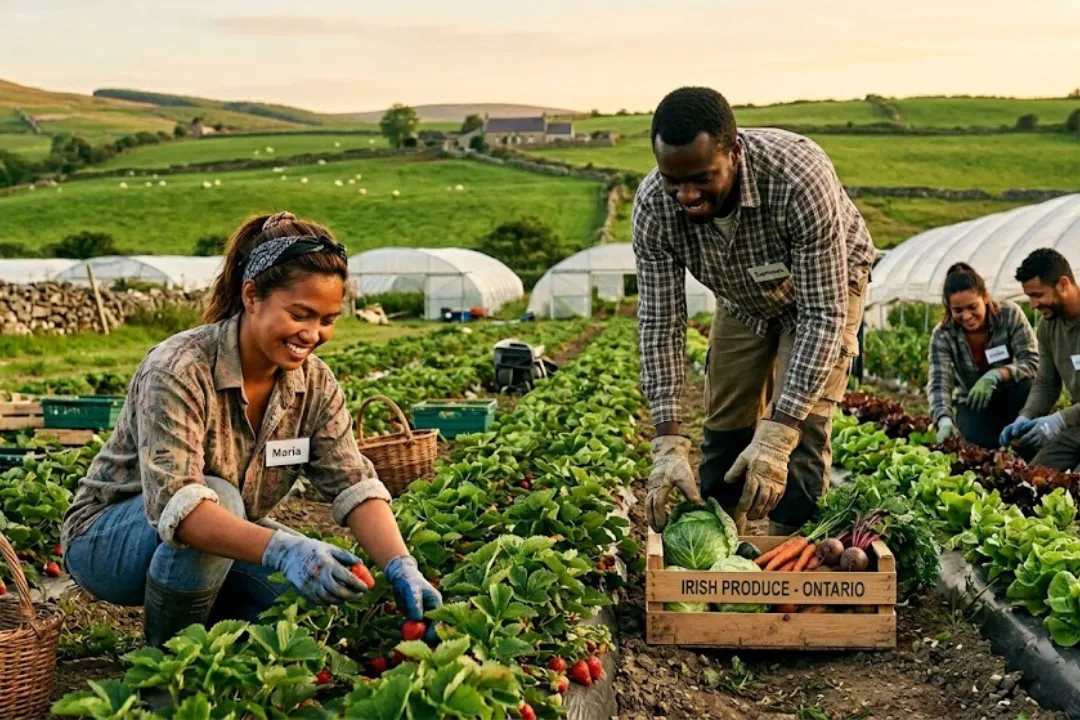
A photorealistic documentary-style photograph of a diverse group of seasonal farm workers in a lush Canadian field during golden hour — a young Filipino woman smiling while picking strawberries, a tall African man loading harvested vegetables into a crate, and a South Asian couple working side by side in the background rows. Rolling green farmland stretches behind them under a warm amber sky. Authentic, candid, joyful atmosphere — not staged or stock-photo-like. Natural warm lighting, slightly dusty work clothes, genuine expressions of hard work and contentment.
The Opportunity That Comes with Fresh Air, Fair Pay & a Place to Sleep
What if your next job came with a paycheck, a work permit, and a roof over your head — all in one package? That’s exactly what thousands of farm workers are discovering through Canada’s seasonal agricultural programs in 2026.
Canada’s farming industry is one of the country’s most vital economic sectors, and it has a not-so-secret challenge: there aren’t enough local workers to harvest the crops. From the apple orchards of British Columbia to the vegetable fields of Ontario and the grain farms of Saskatchewan, Canadian farmers are actively recruiting international workers — and many of them are offering free or subsidized accommodation as part of the deal.
Whether you’re looking for a short-term income boost, a gateway into Canada, or a stepping stone toward permanent residency, farm jobs in Canada in 2026 could be exactly the opportunity you’ve been looking for. Let’s break down everything — who’s hiring, what you’ll earn, how the visa works, and how to apply today.
Why Canada Needs Farm Workers So Badly in 2026
Canada produces billions of dollars worth of agricultural products every year — fruits, vegetables, grains, dairy, and more. But harvesting, planting, and maintaining those farms requires enormous amounts of physical labour, and it needs to happen at very specific times of year.
The problem? Canada doesn’t have enough domestic workers willing to take on seasonal farm roles. Young Canadians are increasingly moving into urban areas and office-based careers, leaving a massive labour gap in the agricultural sector.
What’s Driving the Demand:
- Canada’s aging rural population and declining local farm workforce
- Expanding agricultural exports requiring more production
- Government commitment to food security and rural development
- Increasing farm sizes requiring more seasonal labour
- Record international recruitment targets under Canada’s agricultural worker programs
This labour shortage is your opportunity.
Types of Farm Jobs Available in Canada 2026
One of the best things about Canadian farm jobs is the sheer variety. You don’t need a specific skill set — if you’re physically fit, reliable, and ready to work outdoors, there’s a role for you.
Common Farm Job Roles:
- Fruit Picker – Apples, strawberries, blueberries, cherries (BC, Ontario, Quebec)
- Vegetable Harvester – Potatoes, carrots, onions, tomatoes (Ontario, Alberta, PEI)
- Greenhouse Worker – Year-round work in controlled growing environments
- Livestock Farm Helper – Feeding, cleaning, and caring for animals
- Nursery Worker – Planting and maintaining trees, shrubs, and plants
- General Farm Labourer – Multi-task support across planting and harvest cycles
- Irrigation & Equipment Helper – Assisting with watering systems and basic machinery
Seasonal Work Calendar:
| Season | Months | Primary Regions |
| Spring Planting | March – May | Ontario, Quebec, BC |
| Summer Harvest | June – August | BC, Alberta, Manitoba |
| Fall Harvest | September – November | Ontario, PEI, Nova Scotia |
| Year-Round | All Year | Greenhouse farms across Canada |
Free Accommodation – What Does It Actually Look Like?
Let’s address the question everyone asks first: Is the free housing actually decent?
The honest answer is — it varies, but it’s regulated. Under Canada’s Seasonal Agricultural Worker Program (SAWP) and the Agricultural Stream of the Temporary Foreign Worker Program, employers are legally required to provide workers with safe, adequate housing that meets provincial standards.
What’s Typically Included:
- Shared dormitory-style housing on or near the farm property
- Basic furnishings — bed, storage, common kitchen area
- Utilities included — electricity, water, heating
- Transportation — many farms provide rides to nearby towns for groceries and errands
- Some farms offer Wi-Fi access and recreational common areas
A small housing deduction may be taken from your paycheck (usually $30–$50/week CAD), but this is minimal compared to renting accommodation independently. For most workers, the savings are significant.
How Much Do Farm Workers Earn in Canada?
Pay varies by province, crop type, and whether you’re paid hourly or by piece rate (per unit harvested). Here’s a realistic breakdown:
| Role | Hourly Rate (CAD) | Weekly Earnings (Approx.) |
| General Farm Labourer | $17 – $22 | $680 – $880 |
| Fruit Picker | $16 – $21 + piece rate | $700 – $1,100+ |
| Greenhouse Worker | $18 – $24 | $720 – $960 |
| Livestock Helper | $18 – $23 | $720 – $920 |
| Experienced Farm Supervisor | $25 – $35 | $1,000 – $1,400 |
Many workers report that piece-rate picking jobs — where you’re paid per bin or per kilogram — can push earnings significantly higher if you’re fast and consistent. Some experienced fruit pickers earn well over $1,200 per week during peak harvest season.
And remember — with free or low-cost accommodation, most of what you earn goes directly into your pocket.
A Real Story: Maria’s Journey from the Philippines to Ontario Farmland
Maria, a 32-year-old mother of two from Cebu, Philippines, had worked in domestic service for years. When she heard about Canada’s Seasonal Agricultural Worker Program through a government-registered recruitment agency in 2024, she was skeptical — free housing? In Canada?
She applied anyway. Within three months, she had her work permit and was on a flight to Ontario to work at a vegetable farm. Her accommodations were a shared house with five other workers, a five-minute walk from the fields. She worked five to six days a week during the harvest season, earning $19.50/hour.
By the end of her eight-month contract, Maria had saved more money than she had in three years of domestic work. She returned the following season, and her employer — impressed by her reliability — has now submitted a nomination to support her permanent residency application.
Her message? “The work is hard, but it’s honest. And Canada treats you with respect.”
Visa & Work Permit Options for Farm Workers in Canada
Getting to Canada legally and safely is the most important step. Here are the main pathways:
1. Seasonal Agricultural Worker Program (SAWP)
Available to citizens of Mexico and participating Caribbean countries. Workers come for up to 8 months and return home after the season. Employers cover flights and housing.
2. Agricultural Stream – Temporary Foreign Worker Program (TFWP)
Open to workers from any country. Requires an employer with a valid Labour Market Impact Assessment (LMIA). Work permits typically last 1–2 years and can be renewed.
3. Rural and Northern Immigration Pilot (RNIP)
Some rural communities with large agricultural sectors offer pathways to permanent residency for farm workers who demonstrate community ties.
4. Provincial Nominee Programs (PNPs)
Provinces like Manitoba, Saskatchewan, and Prince Edward Island actively nominate experienced farm workers for permanent residency through their agricultural streams.
Important Warning: Never pay upfront recruitment fees. Legitimate Canadian employers and registered agencies do not charge job seekers for placements. If someone asks for money to “secure” a Canadian farm job, it’s a scam.
How to Apply for Farm Jobs in Canada 2026
Follow these steps to give yourself the best chance of success:
- Visit the Official Job Bank – Go to jobbank.gc.ca and search “agricultural worker” or “farm labourer.” Filter by province and season.
- Look for LMIA-Approved Listings – These are the job postings that can legally support your work permit.
- Register with AgriRecruiting Agencies – Search for government-approved recruitment agencies in your home country that specialize in Canadian agricultural placements.
- Prepare Your Documents – Valid passport, proof of physical fitness if required, basic English language ability, and any relevant experience (even informal farming background helps).
- Apply Early – Farm hiring happens 3–6 months before the season starts. Apply in December–February for summer positions.
- Get Your Work Permit Processed – Once you have a job offer, your employer will guide you through the LMIA-backed work permit process via IRCC Canada.
FAQs – Farm Jobs in Canada 2026
Q: Do I need farming experience to apply for Canadian farm jobs? A: No formal experience is required for most entry-level roles like fruit picking or general labour. A willingness to work hard outdoors and basic physical fitness are the main requirements.
Q: Is the free accommodation really included in Canadian farm jobs? A: Yes — under SAWP and the Agricultural Stream TFWP, employers are legally required to provide adequate housing. A small deduction may apply but is typically very affordable.
Q: Can farm workers in Canada apply for permanent residency? A: Yes. Many farm workers transition to permanent residency through Provincial Nominee Programs, the Rural and Northern Immigration Pilot, or Express Entry after gaining Canadian work experience.
Q: What is the minimum wage for farm workers in Canada? A: Minimum wages vary by province but range from $15.60 to $17.40 CAD/hour. Most farm jobs pay above this, and piece-rate work can significantly increase earnings.
Q: How long is a typical farm work contract in Canada? A: Contracts typically run from 4 to 8 months depending on the season and crop. Some greenhouse positions offer year-round contracts of 12+ months.
Final Thoughts – Hard Work in Fresh Air, and a Future Worth Building
We understand that leaving home — even temporarily — is never a small decision. You’re thinking about your family, your finances, your future. And we want you to know: those concerns are valid, and your ambitions are worth chasing.
Farm work in Canada isn’t glamorous. The days are long, the sun can be relentless, and your back will definitely know you worked hard. But there’s something deeply satisfying about honest labour in wide-open spaces — and the financial and immigration rewards that come with it are very real.
Every year, thousands of people from dozens of countries arrive in Canada’s fields and leave with savings, experience, and in many cases, a new life. You could be one of them.
The season is coming. The farms are waiting. And the opportunity — free housing included — is right there for the taking.
Take the first step today. Apply early, apply smart, and trust the process.
Keywords Used:
- Farm jobs in Canada 2026
- Seasonal farm work Canada free accommodation
- Agricultural worker visa Canada
- LMIA approved farm jobs Canada
- Temporary Foreign Worker Program agriculture
- Canada farm worker permanent residency
- Seasonal Agricultural Worker Program Canada