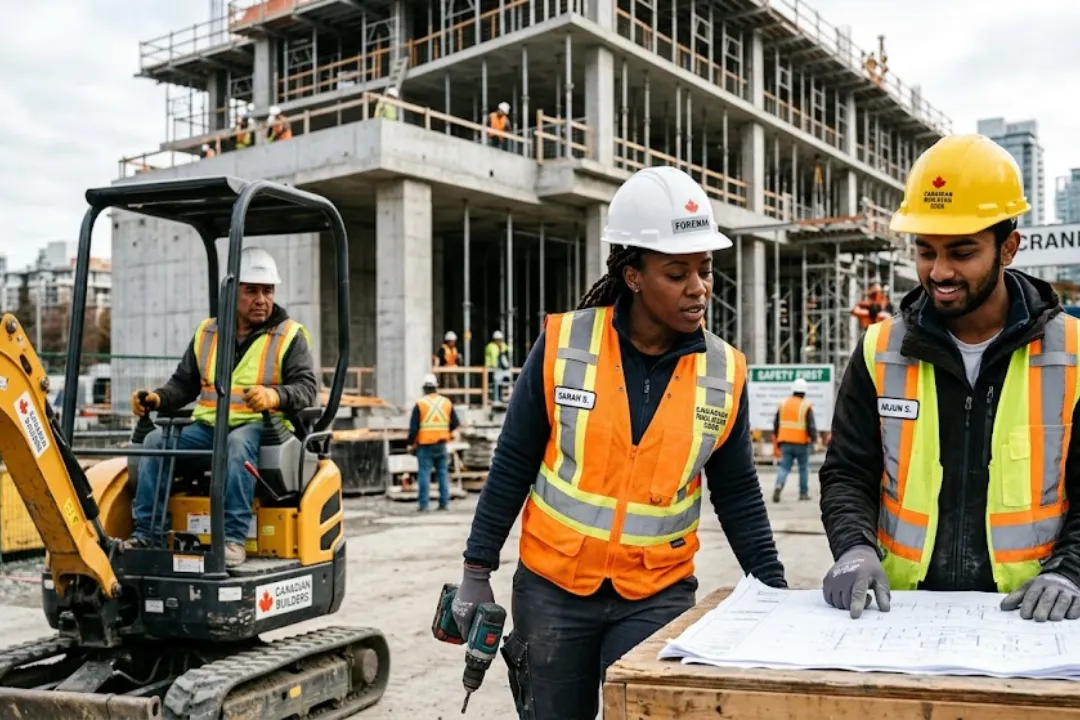
A photorealistic scene showing a diverse group of construction workers on a Canadian job site in 2026 — a South Asian man in a yellow hard hat reviewing blueprints, a Black woman in an orange safety vest carrying equipment, and a Latino worker operating a small machine in the background. Bright morning sunlight, a half-built structure behind them, warm and energetic atmosphere, authentic documentary-style photography, not staged.
Imagine waking up every morning, putting on your hard hat, and earning a solid paycheck in one of the world’s most stable and welcoming countries. That’s not a dream — for thousands of people around the world, that’s exactly what a construction job in Canada in 2026 looks like.
Canada’s construction industry is booming. With massive infrastructure projects, housing development programs, and government-backed investment pouring into cities like Toronto, Calgary, Vancouver, and Ottawa, the demand for construction workers has never been higher. And here’s the part that surprises most people — you don’t need experience to get started.
Whether you’re a first-time job seeker, a career changer, or someone looking to build a better future abroad, Canada’s construction sector is actively welcoming workers from all backgrounds. In this guide, we’ll walk you through everything you need to know — available roles, salary expectations, visa options, and exactly how to apply today.
Why Canada’s Construction Industry Is Hiring in 2026
Canada is in the middle of a construction revolution. The federal government has committed billions of dollars to affordable housing, public transit, and green infrastructure. According to industry projections, Canada needs over 300,000 new construction workers by 2030 to meet demand.
What does that mean for you? It means employers are actively recruiting — not just locally, but internationally. Many companies are offering visa sponsorship, relocation support, and even free or subsidized housing to attract qualified and semi-qualified workers.
Key Factors Driving Demand:
- Major housing shortages in cities like Toronto, Vancouver, and Calgary
- Large-scale government infrastructure investment programs
- An aging local workforce creating thousands of vacancies
- Canada’s aggressive immigration targets welcoming skilled and unskilled workers
This is genuinely one of the best windows of opportunity for international job seekers in recent memory.
Construction Jobs Available in Canada 2026 – No Experience Needed
You might be surprised at just how many construction roles are open to people with little or no experience. Many employers provide on-the-job training, making this one of the most accessible industries to enter.
Entry-Level Roles (No Experience Required):
- General Labourer – Moving materials, cleaning sites, assisting tradespeople
- Construction Helper – Supporting carpenters, electricians, and plumbers
- Site Cleaner / Waste Removal Worker – Keeping job sites organized and safe
- Material Handler / Loader – Operating basic equipment, lifting and transporting materials
- Flagging / Traffic Control Worker – Managing vehicle flow around construction zones
Mid-Level Roles (Some Training or Certifications Helpful):
- Scaffolding Worker
- Concrete Finisher
- Drywall Installer
- Roofer
- Formwork Carpenter
Even for mid-level roles, many Canadian employers will sponsor your training if you show up with the right attitude and a willingness to learn.
How Much Do Construction Workers Earn in Canada?
Let’s talk money — because that’s what matters most when you’re planning a move or a career change.
| Role | Average Hourly Wage (CAD) | Annual Salary (Approx.) |
| General Labourer | $18 – $24 | $37,000 – $50,000 |
| Construction Helper | $20 – $26 | $41,000 – $54,000 |
| Concrete Finisher | $25 – $35 | $52,000 – $73,000 |
| Carpenter | $28 – $40 | $58,000 – $83,000 |
| Site Supervisor | $35 – $55 | $73,000 – $114,000 |
Many employers also offer overtime pay, benefits packages, and housing allowances — especially for international hires relocating from abroad.
Visa & Work Permit Options for Construction Workers
This is the section most people are searching for — and rightfully so. Getting the right visa is the key that unlocks everything else.
1. Temporary Foreign Worker Program (TFWP)
This is the most common pathway for international construction workers. Canadian employers with a Labour Market Impact Assessment (LMIA) can hire foreign workers directly, often sponsoring your work permit.
2. Express Entry – Federal Skilled Trades Program
If you have experience in a trade (carpentry, plumbing, electrical), you may qualify for permanent residency through Express Entry. Points are awarded for age, education, language skills, and job offers.
3. Provincial Nominee Programs (PNPs)
Provinces like Alberta, British Columbia, Ontario, and Saskatchewan have their own immigration streams for construction workers. These can fast-track your application significantly.
4. Atlantic Immigration Program
If you’re open to working in Nova Scotia, New Brunswick, PEI, or Newfoundland, this program offers a faster route to permanent residency with employer support.
Pro Tip: Always work with a licensed Canadian immigration consultant (RCIC) or lawyer to avoid scams and ensure your application is filed correctly.
A Real Story: From Pakistan to a Calgary Job Site
Meet Usman, a 29-year-old from Lahore, Pakistan. He had no formal construction training but had worked in basic labour roles back home. In early 2025, he found an LMIA-approved job listing from a Calgary-based construction firm through a licensed recruitment agency.
Within four months, he had his work permit approved, flew to Canada, and started as a general labourer earning $22/hour. By month six, his employer enrolled him in a scaffolding certification course — paid for by the company. Today, Usman earns $28/hour and is preparing his Express Entry profile for permanent residency.
His advice? “Don’t wait for the perfect moment. Apply, be honest about your experience, and show that you’re willing to work hard. Canada rewards that.”
How to Apply for Construction Jobs in Canada 2026
Here’s your step-by-step roadmap:
- Research Legitimate Job Boards – Use Job Bank Canada (jobbank.gc.ca), Indeed Canada, Workopolis, and LinkedIn. These are the most reliable platforms.
- Look for LMIA-Approved Postings – These are the jobs that can sponsor your work permit.
- Prepare Your Resume – Keep it simple, honest, and focused on physical skills, reliability, and any relevant experience.
- Get Language Ready – A basic level of English (or French for Quebec) is usually required. IELTS is often needed for visa applications.
- Apply Through Licensed Recruitment Agencies – In your home country, look for agencies registered with Canadian authorities. Never pay upfront fees — legitimate agencies are paid by employers.
- Submit Your Visa Application – Once you have a job offer, your employer or their LMIA will support your work permit application through IRCC (Immigration, Refugees and Citizenship Canada).
- Prepare for Arrival – Arrange accommodation, understand your contract, and connect with local immigrant support services.
FAQs – Construction Jobs in Canada 2026
Q: Can I get a construction job in Canada with no experience? A: Yes! Many entry-level roles like general labourer and construction helper require no prior experience. Employers often provide on-the-job training and certifications.
Q: Do Canadian construction employers offer visa sponsorship? A: Many do, particularly those with LMIA approval. Always check job listings specifically for “LMIA-approved” or “willing to sponsor work permit.”
Q: How long does it take to get a Canadian work permit for construction? A: Processing times vary but typically range from 4 to 12 weeks depending on your country of origin and the visa stream used.
Q: What is the minimum wage for construction workers in Canada? A: Minimum wage varies by province (ranging from $15 to $17.50 CAD/hour), but most construction roles pay significantly above minimum wage — often starting at $18–$22/hour.
Q: Is it possible to get permanent residency through a construction job in Canada? A: Absolutely. Many construction workers transition to permanent residency through Express Entry (Federal Skilled Trades), Provincial Nominee Programs, or the Atlantic Immigration Program.
Final Thoughts – Your Hard Work Deserves a Better Stage
We know that making the decision to work abroad — or even just switch careers — isn’t easy. It takes courage, planning, and a whole lot of belief in yourself. But here’s what we want you to remember: Canada was built by people who showed up ready to work. That tradition continues in 2026.
Whether you’re sending money home to your family, saving for your own future, or simply looking for a place where hard work is genuinely rewarded — Canada’s construction industry might just be the opportunity you’ve been waiting for.
You don’t need to be perfect. You don’t need years of experience. You just need to take the first step — update that resume, find that job listing, and hit apply.
The job site is ready. Are you?
Keywords Used:
How to apply for construction jobs in Canada
Construction jobs in Canada 2026
No experience construction jobs Canada
Canada work permit construction workers
LMIA approved construction jobs
Visa sponsorship construction Canada
Entry level construction jobs Canada