Italy’s logistics and warehousing sector has exploded in recent years. The rise of e-commerce giants, the expansion of Italian export industries, and massive investment in distribution infrastructure have created thousands of warehouse jobs in Italy that are actively recruiting foreign workers in 2026. If you’re looking for stable, full-time employment with genuine career progression, a structured salary, and a clear visa pathway into Europe, the Italian warehousing sector deserves your full attention.
In this detailed guide, you’ll find everything you need: job types, salary ranges, visa requirements, and a step-by-step application roadmap.
Italy’s Warehouse & Logistics Boom in 2026
Several converging trends are fueling unprecedented demand for warehouse workers in Italy:
- Amazon, Zalando, and IKEA have expanded their Italian distribution networks
- Italian fashion and luxury goods exports require sophisticated warehousing logistics
- Food and pharmaceutical distribution has grown significantly post-pandemic
- Northern Italy’s logistics triangle (Milan–Verona–Bologna) is one of Europe’s busiest
Employers in this sector are not just looking to fill vacancies — they’re building long-term teams, which means there are real opportunities for permanent contracts, skills development, and career growth.
Types of Warehouse Jobs Available in Italy 2026
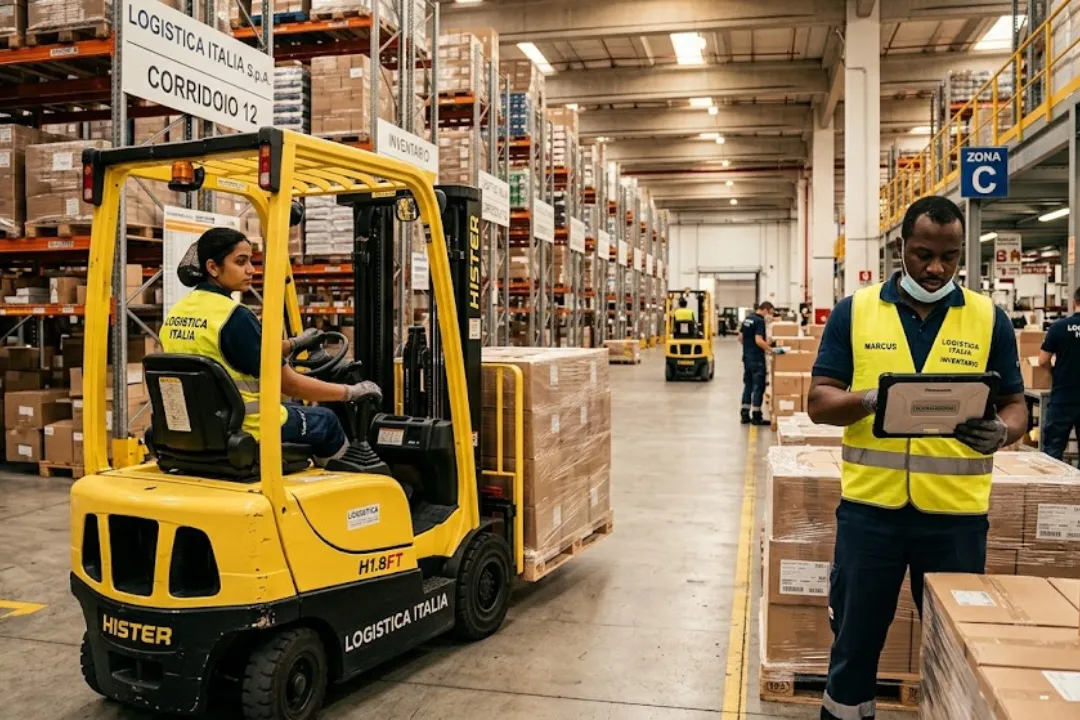
- Order picker / warehouse operative: Picking, packing, and processing customer orders
- Forklift operator (carrellista): Moving pallets and loading/unloading trucks
- Goods receiving / dispatch clerk: Checking and recording inbound/outbound stock
- Inventory controller: Monitoring stock levels using WMS (Warehouse Management Systems)
- Warehouse shift supervisor: Managing teams of 5–20 warehouse workers per shift
- Cold storage operative: Working in refrigerated warehouses for food/pharma logistics
Warehouse Worker Salary in Italy 2026
Warehouse salaries in Italy are governed by the national logistics and transport collective agreement (CCNL Logistica, Trasporto e Spedizione), ensuring legal minimums and worker protections:
- Entry-level picker/packer: €1,300 – €1,700/month
- Forklift operator (certified): €1,700 – €2,200/month
- Experienced logistics operative: €1,900 – €2,400/month
- Warehouse team leader: €2,300 – €2,900/month
- Warehouse manager: €3,000 – €4,500/month
Overtime, night shifts, and weekend premiums regularly push monthly earnings above base figures. Many large employers also offer annual bonuses, meal vouchers, transportation subsidies, and employee discount programs.
Real Story: From Zero to Warehouse Supervisor in Three Years
James, a 31-year-old from Ghana, arrived in Italy in 2022 as a forklift operator at a logistics hub near Verona. He came through a recruitment agency with a valid Category 5 forklift certification from Ghana. Within 18 months, his employer sponsored his WMS (Warehouse Management System) training. By 2025, James was promoted to shift supervisor overseeing a team of 14. ‘Italy gave me structure,’ he says. ‘The rules protect you here. Fixed contracts, paid overtime, proper safety gear. I’ve built something real.’
James’s story isn’t unique — it’s increasingly common for motivated foreign workers who enter Italy’s warehousing sector with the right attitude and documentation.
Visa & Work Permit for Warehouse Jobs in Italy 2026
Decreto Flussi – Logistics Quota
The logistics and warehousing sector is included in Italy’s annual work permit quota. The application process:
- Step 1: Secure a job offer from an Italian logistics employer
- Step 2: Employer files a nulla osta (work authorization) with Sportello Unico Immigrazione
- Step 3: You apply for a work visa at the Italian consulate in your home country
- Step 4: Arrive in Italy and apply for permesso di soggiorno within 8 days
Intra-Company Transfer
For workers employed by multinational companies with Italian operations (DHL, Amazon, Kuehne+Nagel), intra-company transfer permits offer another pathway — particularly for supervisory and managerial roles.
Forklift Certification – A Game-Changer
If there’s one qualification that will dramatically boost your chances of landing a warehouse job in Italy, it’s a valid forklift operator certificate. In Italy, forklift operation requires a specific certification (patentino del muletto), and holders command higher salaries and are in extremely high demand. Many training providers in Italy offer forklift certification courses — some employers even fund this training as part of their onboarding.
How to Apply for Warehouse Jobs in Italy 2026
- Prepare a Europass CV with any logistics, warehouse, or physical work experience
- Obtain or document any relevant certifications (forklift, safety, WMS)
- Search on: Indeed.it, InfoJobs.it, Logistics Jobs Italy, LinkedIn
- Contact staffing agencies: Adecco, Randstad, Manpower, Gi Group (all have logistics divisions)
- Apply directly to major employers: Amazon Italia, BRT, GLS, DHL Supply Chain, Kuehne+Nagel
- Check Italy’s ANPAL portal for government-funded logistics placement programs
Frequently Asked Questions
Q: Do I need experience to get a warehouse job in Italy?
A: Not for entry-level positions. Basic physical fitness and reliability are the main requirements. Forklift experience or certification will significantly improve your salary and opportunities.
Q: What are the working hours for Italian warehouse jobs?
A: Standard shifts are 8 hours, typically in rotating morning, afternoon, and night shifts. Full-time contracts are 40 hours/week. Overtime is common in peak periods and paid at premium rates.
Q: Which Italian cities have the most warehouse jobs?
A: The logistics triangle of Milan, Verona, and Bologna has the highest concentration. Other hotspots include Rome, Turin, Florence, and Bari.
Q: Do warehouse employers in Italy provide visa sponsorship?
A: Yes. Large logistics companies and staffing agencies regularly sponsor work permits for non-EU workers through the Decreto Flussi system due to ongoing labor shortages.
Q: Is it possible to get a permanent warehouse contract in Italy?
A: Yes. Many companies offer fixed-term contracts that convert to permanent (tempo indeterminato) contracts after 12–24 months, especially for reliable, skilled workers.
This Could Be Your Year
We want to be honest with you: warehouse work is not glamorous. It can be physically demanding, the shifts can be long, and the environment can be noisy and fast-paced. But it is honest, well-paid work in a country that genuinely protects its workers. Italy’s labor laws, unions, and collective agreements mean you have real rights and real recourse — a level of worker protection that many parts of the world simply don’t offer.
More importantly, warehouse work in Italy is a launchpad, not a ceiling. With every certification you earn, every season you work, and every Italian phrase you learn, you’re building toward something bigger. Don’t underestimate what you’re capable of. Italy’s best logistics stories are written by people just like you.
Conclusion
Warehouse jobs in Italy 2026 offer full-time employment, strong salaries under national collective agreements, and clear visa pathways for non-EU workers. With Italy’s logistics sector booming thanks to e-commerce and export growth, there’s never been more opportunity. Prepare your documents, obtain any relevant certifications, target the right employers and platforms, and apply today. Your Italian logistics career is waiting.