Italy is not only famous for its food — it’s one of Europe’s largest food producers and exporters. Behind every jar of Italian passata, every block of Parmigiano-Reggiano, and every bottle of olive oil is a production line full of workers keeping things moving. And in 2026, those production lines desperately need people like you. Food packing jobs in Italy are among the most accessible entry points into the Italian labor market — no experience, no degree, and in many cases, minimal language skills required.
This guide will show you exactly what the work involves, how much you’ll earn, how to get the right visa, and where to apply today.
What Do Food Packing Workers Actually Do?
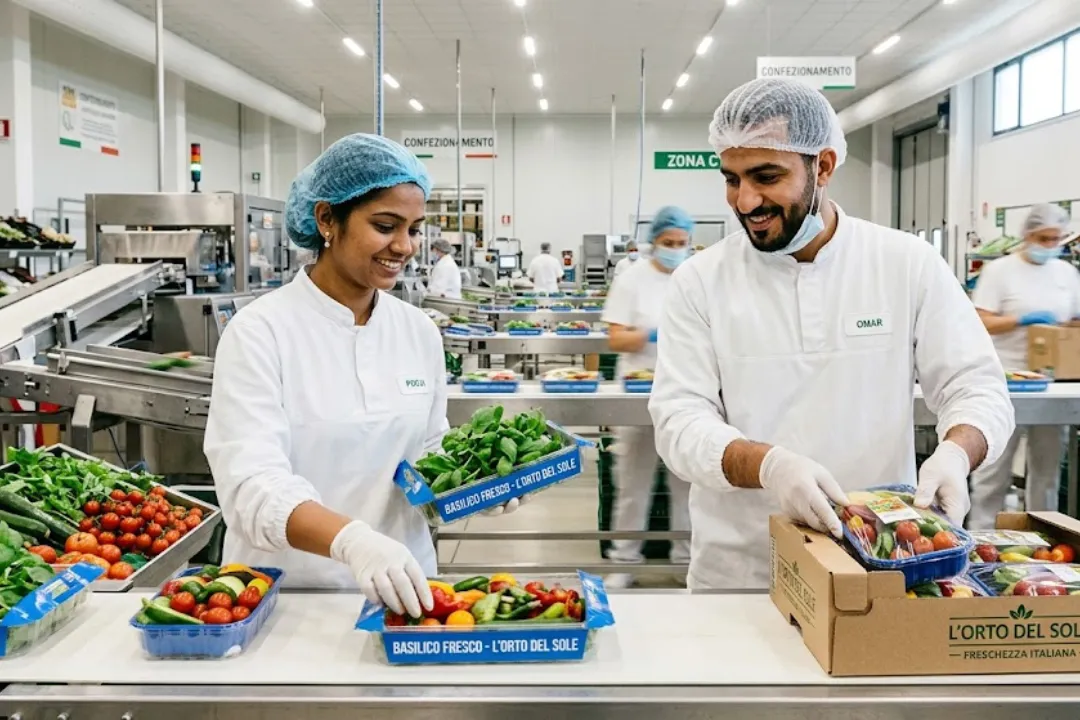
Food packing, or food processing, covers a wide range of tasks inside food production facilities. Here’s what a typical day might look like:
- Sorting and quality-checking fresh produce (tomatoes, peppers, olives, cheese)
- Operating packaging machines and conveyor belt systems
- Labeling, sealing, and boxing finished food products
- Monitoring production line for defects or contamination
- Maintaining hygiene standards in compliance with EU food safety regulations
The work is indoors, structured, and physical but not overly strenuous. Shifts typically run 8 hours, with some facilities offering 12-hour shifts with higher hourly rates.
Food Packing Worker Salary in Italy 2026
Wages in Italy’s food processing sector are regulated by the national CCNL Industria Alimentare (Food Industry Collective Agreement), which protects workers’ rights and ensures fair pay:
- Entry-level packing/sorting worker: €1,200 – €1,600/month
- Experienced line operator: €1,600 – €2,000/month
- Machine operator / quality control: €1,900 – €2,400/month
- Shift supervisor / team leader: €2,400 – €3,000/month
Night shifts and weekend work typically carry a premium of 20–30% above the base hourly rate. Overtime is regulated and paid accordingly. Some employers also provide canteen meals, transportation, and production bonuses.
Top Regions for Food Packing Jobs in Italy
- Emilia-Romagna: Parma (Parmigiano, prosciutto), Bologna (mortadella, pasta)
- Campania: Salerno and Naples (tomato processing, pasta, mozzarella)
- Puglia: Bari and Taranto (olive oil, tomatoes, wine)
- Sicily: Palermo and Catania (citrus, olive oil, canned fish)
- Trentino-Alto Adige: Trento (apple processing, dairy, fruit juices)
Visa Options for Food Factory Workers in Italy 2026
Decreto Flussi – Industrial/Food Processing Quota
Non-EU workers can enter Italy’s food industry through the annual work permit quota. The food manufacturing sector is consistently included in the industrial and manufacturing allocation. Key steps:
- A confirmed job offer from an Italian food company is required
- The employer submits an authorization request to the Sportello Unico for Immigration
- You apply for your work visa at the Italian consulate in your home country
- Upon arrival, you apply for a permesso di soggiorno (residence permit)
Fatima, a 24-year-old from Senegal, secured a food packing role with a pasta manufacturer in Bologna through a recruitment agency. ‘I had never worked in a factory before,’ she explains. ‘They trained us for two weeks before we even touched the machines. By month three, I was training new arrivals.’
How to Apply for Food Packing Jobs in Italy 2026
- Prepare a simple CV — even without experience, list any physical or factory work
- Search on Indeed.it, InfoJobs.it, Manpower Italy, and Adecco Italia
- Target food industry recruitment agencies: Gi Group Food, Synergie, Humangest
- Apply directly to major Italian food companies: Barilla, Ferrero, Granarolo, Conserve Italia
- Check the official ANPAL website for publicly funded job placement programs
- Join Italian factory worker Facebook communities and job groups
Frequently Asked Questions
Q: Do I need to speak Italian to work in food packaging in Italy?
A: Not necessarily at entry level. Many facilities have multilingual team leaders, and the physical nature of the work means language barriers are less critical. Basic Italian safety instructions are usually provided in multiple languages.
Q: Are food packing jobs in Italy permanent or temporary?
A: Both. Many start as 6–12 month fixed-term contracts that convert to permanent (contratto a tempo indeterminato) based on performance. Seasonal roles in tomato and citrus processing run 3–5 months.
Q: What are the working hours for food factory jobs in Italy?
A: Typically 40 hours per week across 5 days. Shift work (morning, afternoon, night) is common. Night shifts earn a mandatory legal premium.
Q: Is there room for career advancement in food processing in Italy?
A: Yes. Workers can progress from packing to machine operation, quality control, shift supervision, and even production management with experience and additional training.
Q: Can I bring my family to Italy if I work in food packing?
A: Yes, after 12 months of legal residence and employment, you can apply for family reunification to bring your spouse and dependent children to Italy.
More Than a Job — A Foot in the Door
We understand that ‘food packing worker’ might not be the dream career title you had in mind. But here’s what it actually represents: a legal foothold in one of Europe’s most beautiful countries, a regulated salary, protected worker rights, and the freedom to build toward something bigger. Learn Italian in the evenings, get your safety certifications, save money, and explore Italy on weekends. The people who turn seasonal factory jobs into life-changing Italian careers are the ones who show up, do the work, and keep their eyes open.
You don’t need experience. You need a plan and the courage to start. This is yours.
Conclusion
Food packing jobs in Italy 2026 are genuinely accessible to workers with no formal experience, offering regulated salaries, legal work permits through the Decreto Flussi, and a real pathway to long-term Italian residency. From Parma’s cheese factories to Sicily’s citrus processing plants, opportunities are waiting across the country. Prepare your CV, target the right platforms and employers, and apply today — your Italian chapter is just one application away.