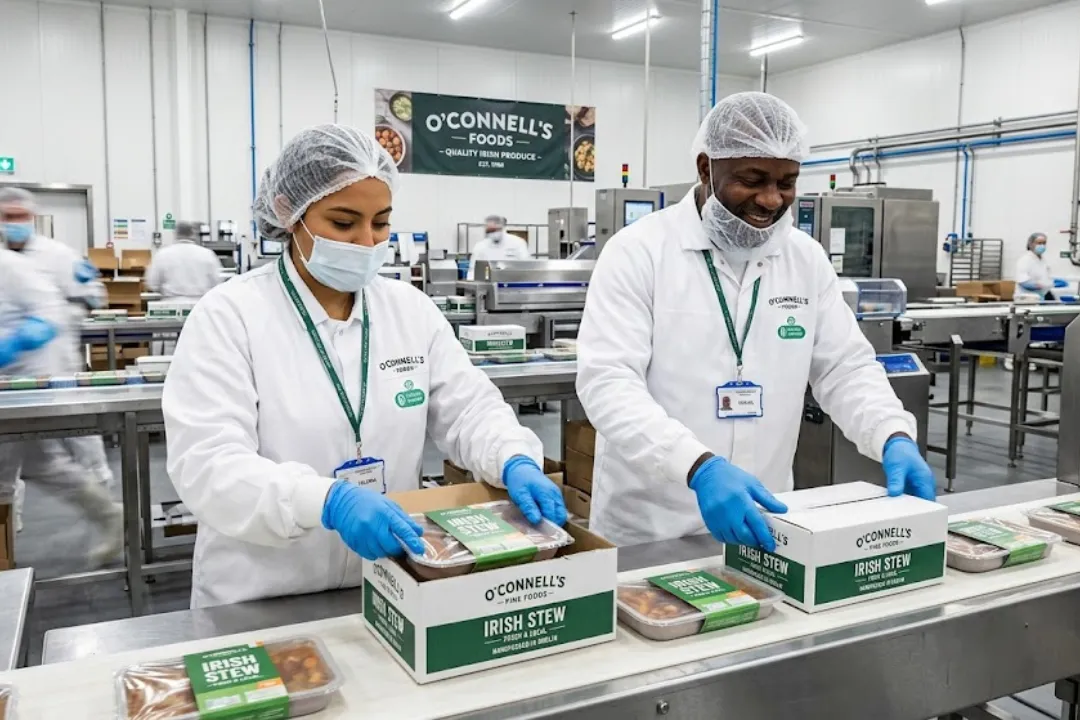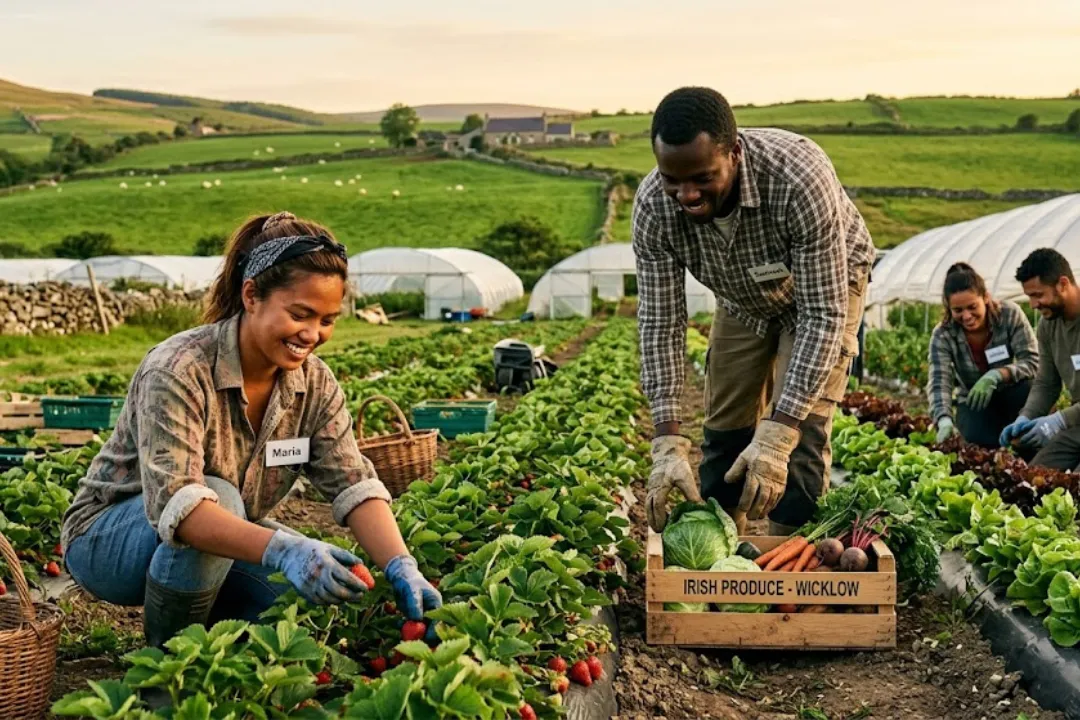
A photorealistic documentary-style photograph of a diverse group of seasonal farm workers in lush Irish countryside during golden hour — a young Filipina woman smiling warmly while picking strawberries in a green field, a tall Nigerian man carefully loading harvested vegetables into a wooden crate, and a Brazilian couple working side by side in the background rows of a polytunnel. Rolling emerald Irish hills and stone walls stretching behind them under a soft amber sky. Authentic, candid, joyful atmosphere — worn work gloves, genuine expressions of quiet pride and honest effort, not staged or stock-photo-like.
Ireland’s Green Fields Are Calling — and There’s a Bed Waiting for You
There’s a reason Ireland is called the Emerald Isle. Its farmland is some of the most fertile and productive in all of Europe — rolling green fields, rich soil, and a climate perfectly suited to growing some of the continent’s most prized fruits, vegetables, and dairy products. And in 2026, those fields need workers.
Ireland’s agricultural sector is facing one of the most significant labour shortages in its modern history. From strawberry farms in Wexford to mushroom houses in Monaghan, from potato fields in Donegal to apple orchards in Tipperary, Irish farmers are struggling to find enough hands to plant, tend, and harvest their crops — and they’re increasingly turning to international workers to bridge that gap. Many of them are offering free or subsidized accommodation as part of the deal.
Whether you’re looking for a short-term seasonal income, a legitimate pathway into Europe, or a first step toward building a life in Ireland, farm jobs in 2026 offer one of the most accessible and genuine opportunities available to international workers today. This guide covers everything — what roles are available, what you’ll earn, how the housing works, what visa options exist, and exactly how to apply.
Why Ireland’s Farming Sector Is Desperately Hiring in 2026
Agriculture is one of Ireland’s most economically vital industries. Ireland exports billions of euros worth of food and drink every year — dairy, beef, seafood, cereals, and fresh produce — making it one of the world’s most significant food exporters relative to its population size. Keeping that engine running requires a massive seasonal and year-round workforce.
What’s Driving the Labour Shortage:
- A shrinking rural population as young Irish workers migrate to urban centres and service industries
- An aging farming workforce with fewer family members entering the profession
- Rapid expansion of Ireland’s horticultural sector driven by growing EU food demand
- Post-Brexit changes to the UK labour market disrupting traditional seasonal worker flows into Irish farms
- Ireland’s government commitment to growing domestic food production for national and export security
The result is a sector where reliable, hardworking international workers are not just welcomed — they are essential. Irish farmers who once relied entirely on local labour are now actively partnering with recruitment agencies and government programs to bring workers from across the world.
Types of Farm Jobs Available in Ireland 2026
Irish farming is diverse — from large commercial horticultural operations to family-run livestock farms — and the range of available roles reflects that variety.
Fruit & Vegetable Picking Roles:
- Strawberry Picker – Ireland’s most sought-after seasonal role, concentrated in Wexford, Waterford, and Cork from May to August
- Raspberry & Blueberry Picker – Soft fruit harvesting across Munster and Leinster through summer months
- Apple Picker – Orchard harvesting in Tipperary and Kilkenny from late August through October
- Vegetable Harvester – Harvesting potatoes, carrots, cabbages, and onions across the midlands and north
- Salad Crop Picker – Lettuce, spinach, and mixed leaf harvesting in polytunnels year-round
Horticulture & Growing Roles:
- Polytunnel Worker – Planting, pruning, training, and maintaining crops in protected growing environments — often year-round work
- Mushroom Farm Worker – Ireland is one of Europe’s largest mushroom producers; roles include picking, packing, and compost management
- Nursery Worker – Potting, propagating, and maintaining ornamental plants and young crop seedlings
- Greenhouse Assistant – Supporting controlled-environment crop production in tomato and pepper houses
Livestock & Dairy Roles:
- Dairy Farm Assistant – Milking, feeding, and general livestock care on Ireland’s extensive dairy farms
- Beef Farm Helper – Feeding, moving, and managing cattle on commercial beef operations
- Pig Farm Worker – Feeding, cleaning, and monitoring pig welfare in commercial piggeries
- Poultry Farm Worker – Managing broiler and layer flocks in large-scale poultry operations
General Agricultural Labour:
- General Farm Labourer – Multi-task support across planting, growing, harvesting, and farm maintenance
- Irrigation & Equipment Helper – Assisting with watering systems, machinery maintenance, and site logistics
- Farm Packer – Sorting, grading, and packing harvested produce for dispatch to supermarkets and wholesalers
What Do Farm Workers Earn in Ireland in 2026?
Ireland’s agricultural wages have risen significantly in recent years, driven by national minimum wage increases and growing competition for available workers.
| Role | Hourly Wage (EUR) | Weekly Earnings (Approx.) |
| Fruit / Vegetable Picker | €13.50 – €17 | €540 – €680 |
| Polytunnel / Greenhouse Worker | €14 – €18 | €560 – €720 |
| Mushroom Farm Worker | €13.50 – €17 | €540 – €680 |
| Dairy / Livestock Farm Assistant | €14 – €20 | €560 – €800 |
| Farm Packer | €13.50 – €16 | €540 – €640 |
| Experienced Farm Supervisor | €22 – €32 | €880 – €1,280 |
Ireland’s national minimum wage in 2026 is €13.50 per hour — one of the highest agricultural minimum wages in the European Union. All farm workers are legally entitled to this as an absolute floor, and most employers pay above it.
Additionally, many farms operating piece-rate systems — paying per punnet, per kilogram, or per crate — allow fast and motivated workers to earn significantly above hourly rates. Experienced strawberry pickers and mushroom harvesters in Ireland regularly report earning €700–€900 per week during peak season through piece-rate work.
What About Overtime?
Under Irish employment law, overtime arrangements vary by employer, but most farm workers on standard 39-hour contracts receive premium rates for additional hours. Weekend work often attracts a higher rate, and some larger horticultural operations offer structured overtime during peak harvest periods.
Free Accommodation — What Irish Farm Workers Can Actually Expect
This is the question every international applicant wants answered honestly — and the answer, for most Irish farm jobs, is genuinely positive.
Ireland’s agricultural labour shortage has pushed many farmers and large horticultural employers to invest significantly in on-site or nearby staff accommodation to attract and retain workers. This is particularly common in:
- Large soft fruit farms in Wexford, Waterford, and Cork — Ireland’s strawberry and berry heartland, where several major producers have built purpose-built staff accommodation villages
- Mushroom farms in Monaghan, Cavan, and Tipperary — Ireland’s mushroom industry is highly concentrated and competitive for workers; accommodation packages are standard
- Polytunnel and greenhouse complexes in Leinster and Munster — Year-round operations that need stable workforces invest heavily in housing
- Dairy farms in the west and midlands — Live-in arrangements are common on family farms requiring consistent daily milking schedules
What’s Typically Included in Farm Accommodation:
- Shared rooms or dormitory-style housing on or adjacent to the farm
- Fully furnished with bed, wardrobe, and storage space
- Shared kitchen, bathrooms, and common areas
- Utilities — electricity, heating, and water — included
- Wi-Fi access increasingly standard at larger operations
- A weekly accommodation deduction of €50–€100 EUR from your paycheck — legally capped and regulated under Irish employment law
- Transport to nearby towns for shopping and socializing on rest days
When you factor in the cost of private renting in Ireland — which runs €1,200–€1,800 EUR per month in most regions — the effective value of included farm accommodation is enormous. Workers in these arrangements consistently report being able to save €600–€1,000 EUR per month after all living expenses, which is significantly more than urban workers earning comparable wages.
A Real Story: From the Philippines to a Wexford Strawberry Farm
Analyn, a 29-year-old from Cebu in the Philippines, had spent four years working in a call centre before deciding she wanted something different — something that could take her to Europe. When a friend mentioned Ireland’s seasonal farm worker program in late 2023, she was curious but uncertain.
She applied through a POEA-accredited agency for a strawberry picker position with a large Wexford farm. The employer offered a six-month contract from April to September, free shared accommodation in a purpose-built staff house five minutes from the fields, and a starting rate of €14/hour with piece-rate bonuses.
On her best weeks during peak season, Analyn earned over €800. With her accommodation, utilities, and daily transport covered, her monthly savings were higher than her entire monthly salary had been back in Cebu.
At the end of her contract, the farm offered her a return invitation for the following season — and her employer began the process of supporting a General Employment Permit for a year-round polytunnel position.
Her advice? “Ireland surprised me. The people are kind, the countryside is beautiful, and the work is honest. I came for one summer and now I’m planning my future here.”
Visa & Work Permit Options for Farm Workers in Ireland 2026
Understanding Ireland’s immigration framework is essential before you apply. Here’s how it works specifically for agricultural workers:
1. General Employment Permit
The most common pathway for non-EU farm workers in roles that are not on Ireland’s Critical Skills list. Requires a genuine job offer with a minimum annual salary of €34,000 EUR (verify current thresholds with your employer or immigration consultant as these are reviewed annually). The employer must demonstrate they were unable to fill the role locally.
Important Note: Ireland periodically reviews which agricultural roles are eligible for employment permits. Always check the current list on the Department of Enterprise, Trade and Employment website before applying.
2. Seasonal Worker Pathway
Ireland has been developing and expanding seasonal agricultural worker frameworks specifically to address the horticultural labour shortage. These permits are designed for roles lasting up to 7 months and are processed faster than standard employment permits. Check the current status of Ireland’s seasonal agricultural scheme at DETE.ie.
3. Working Holiday Authorisation
Citizens of certain countries — including Argentina, Australia, Canada, New Zealand, South Korea, Japan, Hong Kong, and several others — are eligible for a Working Holiday Authorisation allowing up to 12 months of work in Ireland without needing a formal employment permit. Farm work is fully permitted under this scheme and is an excellent entry route for eligible nationalities.
4. EU/EEA Freedom of Movement
Citizens of any EU or EEA country — including Poland, Romania, Bulgaria, Lithuania, Latvia, Hungary, and all other member states — have the automatic right to live and work in Ireland with no permit required. This makes Ireland one of the most open farm labour markets in Europe for EU citizens.
5. Stamp 1G Transition
Workers already legally in Ireland on student or graduate visas can transition to farm work under certain conditions — check with a registered immigration consultant for your specific eligibility.
Critical Warning: Never pay upfront fees to a recruiter to secure an Irish farm job. All legitimate employers and government-registered recruitment agencies are compensated by the farm operator — not by you. Always verify any agency through Ireland’s Department of Enterprise, Trade and Employment or your home country’s official overseas employment authority.
Step-by-Step: How to Apply for Farm Jobs in Ireland 2026
- Start With Official Irish Job Platforms – Search Jobs.ie, IrishJobs.ie, Indeed Ireland, Recruit Ireland, and Agriculture.ie for current listings. Use search terms like “farm worker Ireland 2026,” “fruit picker accommodation Ireland,” “seasonal agricultural worker Ireland,” and “mushroom farm worker Monaghan.”
- Target Ireland’s Largest Agricultural Employers – Companies like Keelings Farms (fruit and salads), Walsh Mushrooms, Monaghan Mushrooms, Total Produce, and Origin Enterprises are among Ireland’s largest horticultural employers and have established international recruitment processes.
- Apply Early — Farm Hiring Happens Months in Advance – Spring and summer positions are typically filled between January and March. Apply no later than February for peak season roles. Year-round polytunnel and mushroom positions can be applied for at any time.
- Contact Government-Registered Recruitment Agencies in Your Country – Look for agencies in your home country certified to place workers with Irish agricultural employers. Verify their registration through your country’s labour authority and cross-reference with Ireland’s DETE registry.
- Prepare a Simple, Honest CV – Highlight any outdoor work, physical labour, farming background, or food industry experience — even informal. Irish farm employers value reliability and physical capability above formal credentials.
- Demonstrate Basic English Communication – A functional level of English is required for safety instructions and daily communication on Irish farms. This does not need to be advanced — but it must be sufficient for workplace interaction.
- Work With a Licensed Irish Immigration Consultant – For employment permit applications, engage a consultant registered with the Immigration and Residence Council of Ireland to ensure your application is filed correctly and without avoidable delays.
- Understand Your Rights Under Irish Law – The Workplace Relations Commission (WRC) enforces Irish employment standards. Know your entitlements around minimum wage, working hours, rest breaks, and accommodation deductions before you sign any contract.
FAQs – Farm Jobs in Ireland 2026
Q: Do I need farming experience to apply for seasonal farm jobs in Ireland? A: No formal experience is required for the majority of entry-level roles including fruit picking, vegetable harvesting, and general farm labour. Physical fitness, reliability, and willingness to work outdoors in variable weather are the primary requirements.
Q: Is the free accommodation on Irish farms genuinely included? A: Yes — and it is legally regulated. Irish employment law caps the amount employers can deduct for accommodation, protecting workers from wage erosion. Conditions vary by farm, but most operations providing accommodation maintain it to an acceptable standard. Always confirm specifics in your signed employment contract before arrival.
Q: Can EU citizens work on Irish farms without a visa? A: Yes. EU and EEA citizens have the automatic right to live and work in Ireland with no employment permit required whatsoever. This is one of the main advantages of Ireland as a destination for EU farm workers.
Q: What is the minimum wage for farm workers in Ireland in 2026? A: Ireland’s national minimum wage is €13.50 per hour — among the highest agricultural minimum wages in the EU. Many farm employers pay above this, and piece-rate systems can push weekly earnings significantly higher for productive workers.
Q: Can seasonal farm workers in Ireland transition to permanent residency? A: Yes, though it requires time and planning. Workers who transition from seasonal permits to year-round General Employment Permits, accumulate five years of legal residence, and meet language and integration requirements can apply for Long-Term Residency and eventually Irish citizenship by naturalization.
Final Thoughts – Ireland’s Fields Have Always Welcomed the Hardworking
There is something quietly profound about farm work. You arrive, the ground is bare, the season is young — and by the time you leave, the fields are full, the crates are packed, and something has genuinely been created by the work of your hands. Not many careers can say that.
Ireland has a deep, centuries-old relationship with the land — and an equally deep appreciation for the people who tend it. The Irish farming community is known for its warmth, its directness, and its loyalty to workers who give their honest effort. Workers who come to Ireland’s farms ready to work consistently report feeling not just employed but genuinely valued.
We understand the courage it takes to uproot yourself and move to a new country, even temporarily. We understand the anxiety of navigating unfamiliar systems in an unfamiliar language. And we want you to know: the reward for that courage, in Ireland’s case, is very real.
The savings potential is genuine. The experience is enriching. The welcome — in those green, rain-washed fields — is warmer than you might expect.
And for the right person, a summer spent picking strawberries in Wexford or tending polytunnels in Tipperary could be the beginning of something far bigger than a season’s work.
Ireland’s fields are green, the season is coming, and there is a place for you in them.
Apply today — and let Ireland surprise you.